
Auracast vs Hearing Loops
With the introduction of new and innovative technologies to the assistive listening market, it can be frustrating to decide which system is best for your venue. Are established systems like hearing loops the way to go, or are cutting-edge solutions such as Auracast the better choice? Perhaps both. In this post, we're going to explore every option in full detail so you can make the best decision for your space.
At Thunder Hearing & Sound, we've been longtime supporters of hearing loops as the best choice for assistive listening. Over the past 15 years, we've installed nearly 500 loop systems in a variety of venues, ranging from small TV rooms to 6,000-seat auditoriums. Working with such a variety of clients and users has taught us that people consistently prefer hearing loops for three main reasons:
1) Discretion
First, discretion. With a telecoil built into their hearing aid or cochlear implant, users don't need to wear or borrow anything additional. That matters to many people who don't want to feel singled out or identified as needing special assistance.
2) Simplicity
Second, simplicity. Nothing is easier than using your own device. Systems that require picking up a receiver or downloading an app often add confusion and extra steps, especially for first-time users.
3) Sound Quality
Third, sound quality. Hearing loss is highly individual. The clearest, most effective sound is sound that has already been customized for your specific hearing loss, and that only happens when the audio is delivered directly through your own hearing aids. The more severe the hearing loss, the more critical this becomes.
IR (infrared), RF (radio frequency),
& Wi-Fi Assitive Listening - Fail
For many years, hearing loops were the only technology that met all three of these needs. IR and RF systems rely entirely on dedicated receivers, which fail all three criteria. Wi-Fi audio systems, while innovative, suffer from significant latency in live settings, often making speech sound like an echo rather than synchronized audio. They also require smartphones and apps which aren't accessible or comfortable for everyone.

Neck Loops
Neck loops can improve compatibility with IR or RF receivers, but they're not discreet, not as easy to use, and simply don't work well for all users. They can be helpful as a compatibility option, but they should never be viewed as equivalent to a properly installed hearing loop.
Auracast

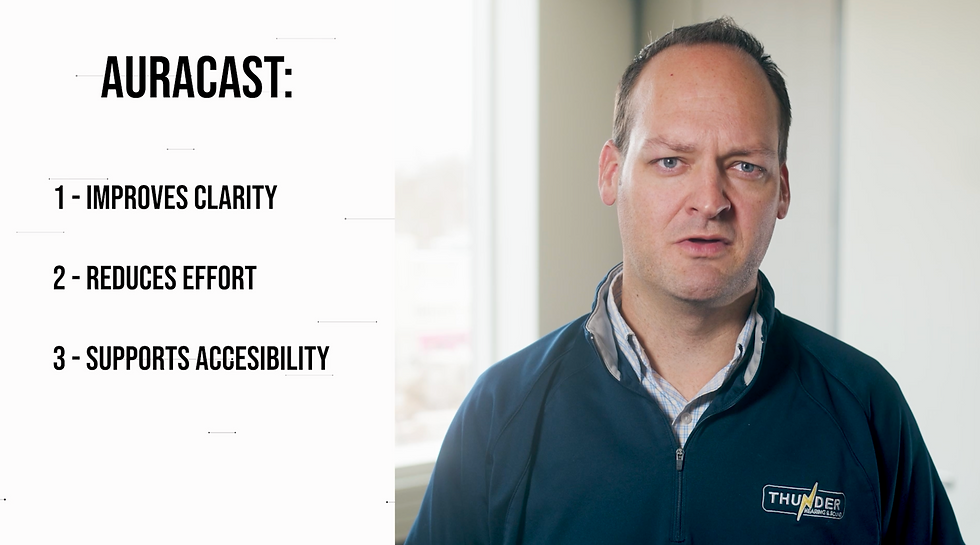
Now, Auracast, a technology that is built on Bluetooth, has entered the picture. Auracast has a major advantage over earlier technologies. It was developed in coordination with hearing aid manufacturers. As a result, Auracast is being built directly into hearing aids. That means, like hearing loops, Auracast can be discreet, relatively easy to use, and capable of delivering high-quality sound directly to the listener's own device. This is a significant step forward and one reason we strongly support Auracast as a technology of the future. That said, let's look more closely at how Auracast compares to hearing loops across several key factors.

Hearing Aid Compatibility
Today, we estimate that roughly 70% of existing hearing aids either have a built-in telecoil or can connect to one through an accessory. As of January, 2026, one manufacturer, GN ReSound, offers all new hearing aids as fully Auracast-enabled. So, today, far more hearing aids work with hearing loops. But this is temporary, as more hearing aid manufacturers are adopting Auracast technology as the standard. Auracast receivers can also be paired with neck loops, though this comes with the same limitations mentioned earlier and should be viewed as a transitional solution.

Latency (Audio Delay)
Hearing loops effectively have zero latency. In fact, in large venues, we sometimes add delay to the loop system to time-align it with the acoustic sound in the room. Auracast does introduce latency, but it is far better than wifi or classic Bluetooth. Typical Auracast latency ranges from about 30 to 50 milliseconds (for the Listen Tech/Ampetronic Auri Transmitter to an Auri Receiver), depending on transmitter design, audio quality settings, and the receiving device. This is acceptable for most applications.
Interference
With hearing loops, interference usually appears as a low-level background hum. This is highly dependent on the building's electrical environment and is often less noticeable or completely unnoticed when listening through hearing aids. As long as the loop meets international standards, this background noise does not affect speech intelligibility. Auracast clearly wins this category. There's no background noise added by the transmission itself, and interference from other 2.4-gigahertz devices like wifi or Bluetooth has not proven to be a practical issue in real-world use.
Multi-Channel
Hearing loops are limited to one audio channel, which can make looping multiple adjacent spaces challenging. Auracast supports multiple channels and stereo audio. So this makes it possible to transmit:
Main program audio
Descriptive audio
One or more languages
Users simply select the stream they want to hear with the "Auracast assistant". While heavy wifi congestion can limit the channel count, most venues can support multiple Auracast streams without issue.
Ease-of-Use
Hearing loops remain the simplest system to use. Listeners just turn their program on or off. Auracast is still straightforward for most users, but slightly more complex than a hearing loop. It relies on an "Auracast assistant" to help devices select the correct audio stream. Depending on the manufacturer, this assistant may be:
Built into the hearing aid app
Provided by the smartphone operating system
Integrated into the receiver or earbuds
As of early 2026, this experience varies, but is expected to become more standardized over time.

Consumer Electronics
Hearing loop receivers never became common consumer electronics. Auracast, on the other hand, already has major electronics manufacturers on board. People who don't yet use hearing aids, but could still benefit from better sound, can buy Auracast-enabled earbuds or headphones today.
Personal Broadcasting
Auracast also supports personal broadcasting, allowing users to share audio from laptops or other devices with multiple nearby listeners. This broader ecosystem will help normalize Auracast use in public spaces.
Auracast or and Hearing Loops
Ultimately, the goal isn't to choose a winning technology. It's to help the most people. Hearing loops serve millions of people today with unmatched simplicity and reliability. Auracast opens the door to future users, new devices, and expanded accessibility features.
The best solution is both. These technologies work extremely well side by side, without interference. Offering both allows venues to support people who rely on hearing aids today, people who will rely on Auracast tomorrow, or users with and without hearing aids. Installing both systems does not mean doubling costs. Receiver quantities can be adjusted based on user needs. And assistive listening works best when people can use their own devices, whether that's a telecoil or an Auracast receiver.
If you'd like to learn more about hearing loops, Auracast, or how to design the right solution for your space, contact the experts at Thunder Hearing & Sound.


Comments